


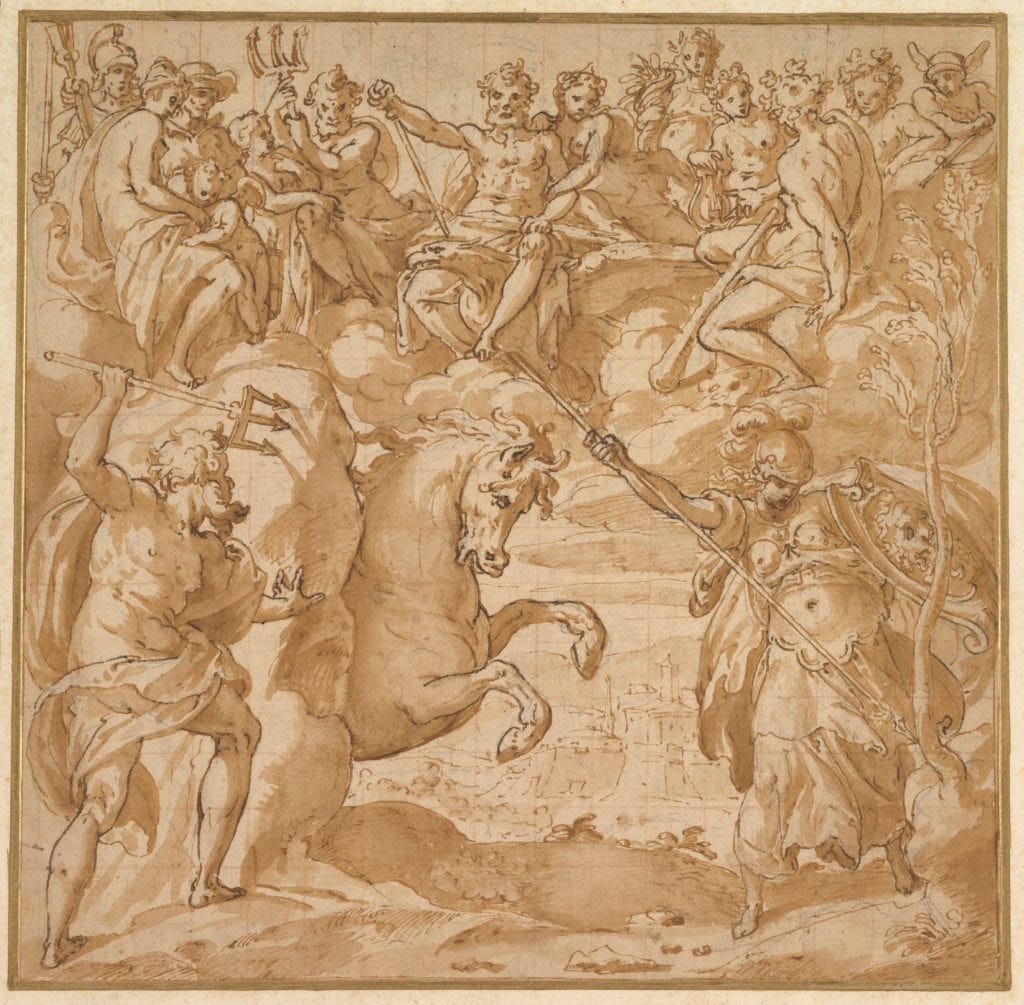
And Poseidon said, “I will give you water,” striking the Acropolis rock with his trident, from which a salty fountain sprang—the gift of the sea.
And Athena said, “I will give you a tree,” striking the rock with her spear, from which an olive tree sprang. “Its fruit will feed you, its leaves will give you shade, its wood and oil will provide you fuel.”
And there was a vote and Athena won; the olive tree was deemed more useful by the Gods. So it would remain and they would name the city in her honor. The city of Athens.
I first met Beatrice at an event in Soho that was hosted by Fora, the travel agency whose ads you’ve probably seen on Instagram. She was walking around, offering guests a taste of her olive oil–called Bea in her honor–which was pooled in a small bowl next to a pile of crusty bread. The first thing you’ll notice when you pour Bea from the bottle is its color. Taken out of context, you might mistake it for Chartreuse, with shades of green and yellow so intense, they border on electric. It’s a kind of vibrancy that only nature can produce, like the color of the sky in the early evening hours in summer, or the white of freshly fallen snow. And when you taste it, the olive oil, you’ll find it’s some of the best you’ve ever had. The kind of thing that makes you wonder how the olive oil you have at home–probably sitting next to the salt and pepper shakers and whatever bottle of vinegar you use for salad dressing–can be considered the same thing.
If I’ve spent years of my career learning how to make good bread and source good wine, then I’ve also seldom considered the quality of the olive oil I use. As it goes, “familiarity is a magician cruel to beauty”1, and we’re quick to grow careless with the things most fundamental to our lives. Olive oil, for its rich history and for its infinite usecases, is easy to take for granted. I use it multiple times a day. It is the most important ingredient in my kitchen. And still I have for so long seen it mostly as a necessary expense, a permanent fixture on my countertop, as something to use up and replace, like a box of tissues or a handful of pocket change.
But then there are certain moments that wake us up from the daze of our everyday–moments that lift the veil, so to speak, and reveal just how much we’ve settled for in fog of the familiar–like the first time you read Kierkegaard or opened a bottle of truly exceptional white Burgundy, then tasting Bea Olive Oil was one of those times. (I don’t think I was the only one who thought this–by the time I left the event, an hour or so after I’d arrived, the plate of bread had diminished to crumbs, the pool of olive oil completely lapped up.) So a few weeks later, still thinking about the olive oil I tried, like one thinks of a pair of shoes they regret not buying, I decided to reach out to Beatrice in order to learn more about her story and process—how she creates an oil that is so fresh and floral, something that tastes like nature and youth. What I learned is that Beatrice, a cybersecurity associate turned CEO of an olive oil company, had also been awakened to new life by the taste of good olive oil. And that Bea ultimately serves as evidence of what happens when you refuse to go back to sleep.
Beatrice and I met for coffee on Christopher Street on one particular hot day in June. She arrived, a few minutes after I, carrying in one hand the dry cleaning, which she’d just picked up at the laundromat around the corner. She was wearing cropped black shorts and a t-shirt which is really the combination of two–a vintage band graphic from Led Zeppelin on the left, another from Pink Floyd on the right, stitched together perfectly down the center. At the time, this meant nothing to me, but now seems an early sign of what I would come to learn: that Beatrice seeks to create in everything she does, a sense of unity and balance. (Later, she reveals that she is, in fact, a Libra, the sign of equal scales, which also makes sense.)
On Christopher Street, steam rose from concrete as the rain which fell earlier from open skies returned to its original form. Beatrice ordered a hot matcha, which was surprising given the heat that lingered in the space despite the air conditioning working over time in the corner. It’s her usual order, she told me, her every action echoing with an indelible self-assuredness that I envied. I ordered some fizzy yuzu drink which is neither my usual order, nor something I even really enjoyed and I sipped it slowly. When we finally sat down, we exchanged a perfunctory set of introductions before jumping into our discussion of her work.
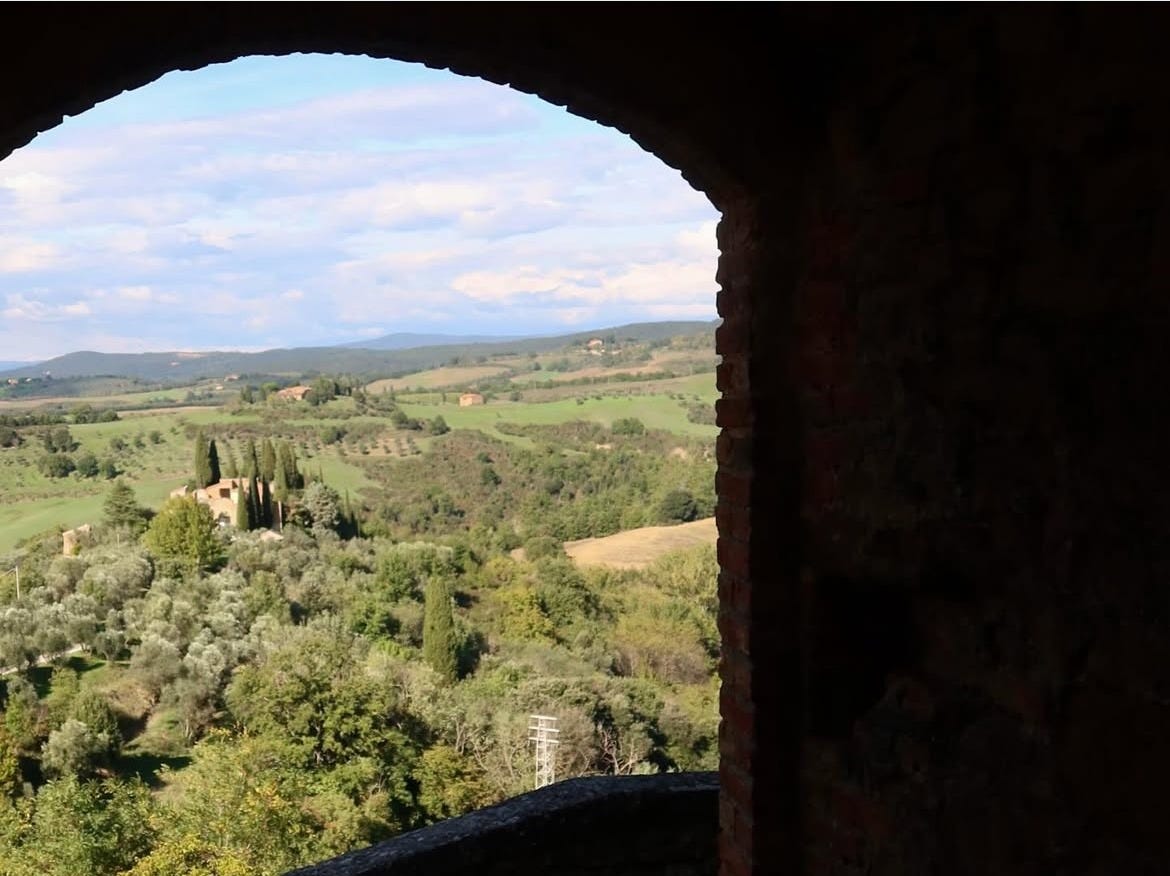
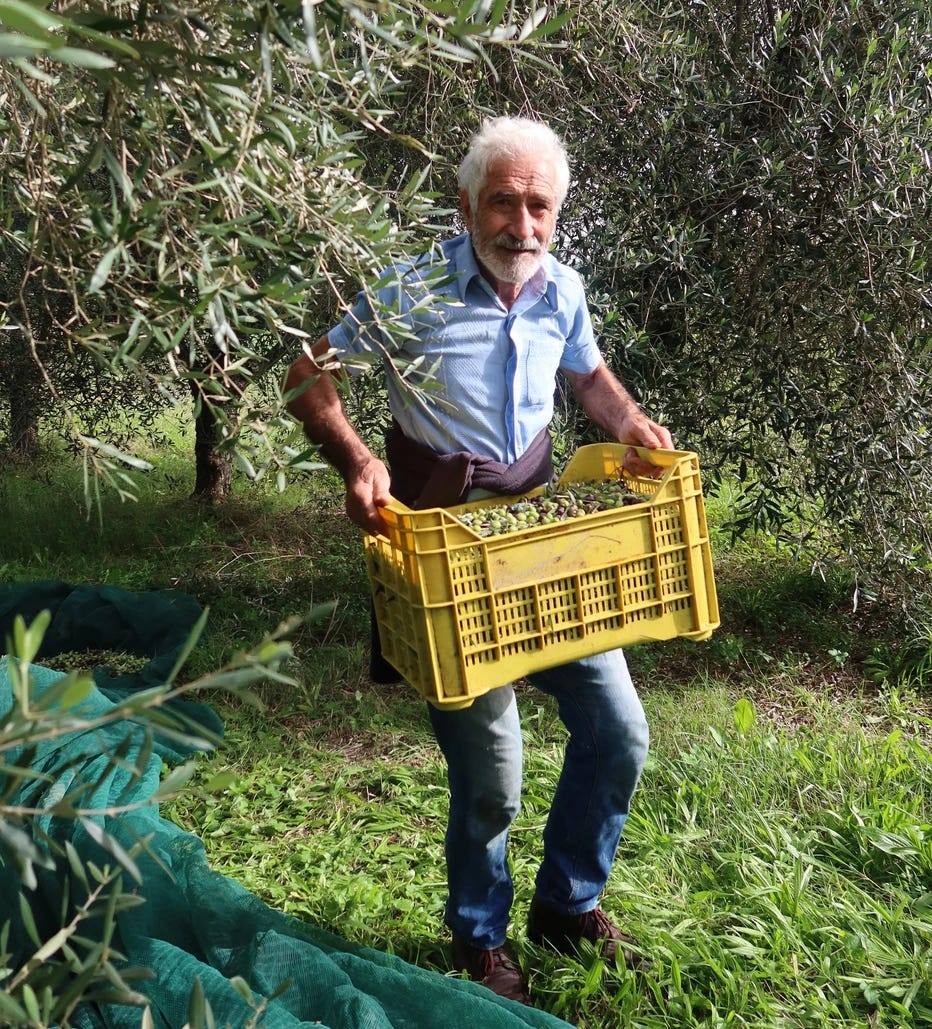
Beatrice began by telling me that after she graduated from school with a job in cybersecurity, as most of her friends moved to big cities to pursue corporate finance, she decided to take some time off and travel. “There is a difference,” she explained, “between education and intellect. In college, I got education, but it left me craving some deeper sense of knowing.” So her father, who built his career in restaurants, connected her with a friend in Italy and a few months after leaving Philadelphia, in the fall of 2022, she landed in Tuscany to work her first olive harvest.
“There is a difference,” she explained, “between education and intellect. In college, I got education, but it left me craving some deeper sense of knowing.”
It was there, she explained, that she had her own experience in “lifting the veil.” Not just in the way of making quality olive oil, but in pursuing a certain Quality of life as well. To be sure, Beatrice didn’t set out to start an olive oil company. Still, all that she learned in that first harvest which served as the basis for her business . She learned that the farmers with whom she worked seldom sell their olive oil. The olive oil they make, pure and unfiltered, is mostly for themselves, a personal supply which they use, tablespoon by tablespoon, over the course of a single year, until the next harvest. Since, she said, younger generations of farmers are flocking to cities, she learned that many of the local groves are dying. She told me that as they lay dying, olive grove ruins pose a threat to the health and longevity of land on which they decompose. That their death meant the death of tradition, the demise of quality, and a collective deference to all that we have come to accept as true.
At this point in our conversation that Beatrice made a point to differentiate between Accepted Truth and Ultimate Truth. In college, Beatrice studied “Science, Technology, and History,” effectively the study of systems–social, political, technological–and their construction. Our Accepted Truths, if you will. But it wasn’t until she took a class outside of her major called Existential Despair, a religious studies course that met once a week from 5pm to midnight, that she started to really examine–and question–the constructs she’d been studying. Here, Beatrice was introduced to the Buddhist idea of Ultimate Truth. The notion that beyond the shifting and evolving constructs of our society, there exists something more unchanging, certain bedrocks of our existence, something harder to define and still more enduring. In essence, the combination of everything that lives beyond our Accepted Truths.
“Have you ever tried to think beyond language?” Beatrice asked me. Admittedly, I hadn’t. Language seems so integral to the way I see the world, it’s the foundation of my work and I’ve haven’t thought much about its constraints, let alone try to venture beyond them. “Harvesting olives was the first time I was able to think without needing to put it into words. It’s the deepest state of meditation I’ve ever known. Olives represent this relationship with the earth that far preempts the human experience. I think olive oil is my ultimate truth,” she tells me.
“I was taught to look for beauty and put myself in the way of it,”
Finding Ultimate Truth requires a sort of rejection of our Accepted Truths, she explained. Of observing systems, norms, the mundane and moving away from them; going in search of something, she tells me, more honest, more beautiful. “I was taught to look for beauty and put myself in the way of it,” she explained. If Beatrice is a disciple of Rejection, then her product is its scripture. The way it’s made, and the way it tastes, is a direct refutation of the olive oil we’ve grown used to consuming.
That olive oil, she tells me, is rarely single origin. It’s often harvested and processed across different regions—or even continents—and then shipped to a central facility to be blended. Sometimes, it’s not olive oil at all and is, in fact, made in large part with seed oils because they’re cheaper to produce and easy to disguise thanks to their neutral flavor. But it is the olive oil we know and is the olive oil we bring into our home and use in our kitchens. We’ve accepted it as our norm–that olive oil can have an almost indefinite shelf life, that it can be as pale as butter, that it comes in large plastic jugs we stash in pantries for years. That all olive oil is created equal. And we’ve accepted these things, up until now, without question.
Ultimately, Bea Olive Oil was created not only in order to bring better olive oil to the market–nor solely to preserve the history and land necessary to this end – but to challenge the things we’ve accepted to be true about the olive oil we consume and the lives we live.
Working directly with Tuscan farmers, Beatrice ensures that all of the olive oil is:
Unrefined and Unfiltered
Single Origin–harvested from single parcels of land in small quantities
Produced with minimal exposure to oxygen and light–two elements most likely to compromise the quality of the oil
Hand marked with the harvest date of each batch to ensure freshness
As for myself, I have not found my Ultimate Truth. But I’d be lying if I said this didn’t all feel part of it. That there is something in Beatrice that I find is true in all of us. That in our deepest, truest selves, we crave meaning and connection. That there is meaning to be found in a life lived in connection with nature as much in connection with ourselves and with others. That meaning can spring from anywhere, like olive groves from rocky ground, if we choose to let it.
How To Buy Good Olive Oil
“Extra-Virgin” should be a given when choosing quality olive oil. It means the oil is extracted mechanically (not chemically) and cold-pressed below a certain temperature. However, as Beatrice points out, while “extra-virgin” appears on most labels, not all EVOOs are created equal, so
Harvest date is more important than the “best by” or “expiration” date. Always look for a recent harvest (ideally within the last year) to ensure freshness. Keywords like “early harvest” or “fresh pressed” are also helpful — they indicate the oil was made from less ripe olives, which tend to have higher antioxidant content and more robust flavor.
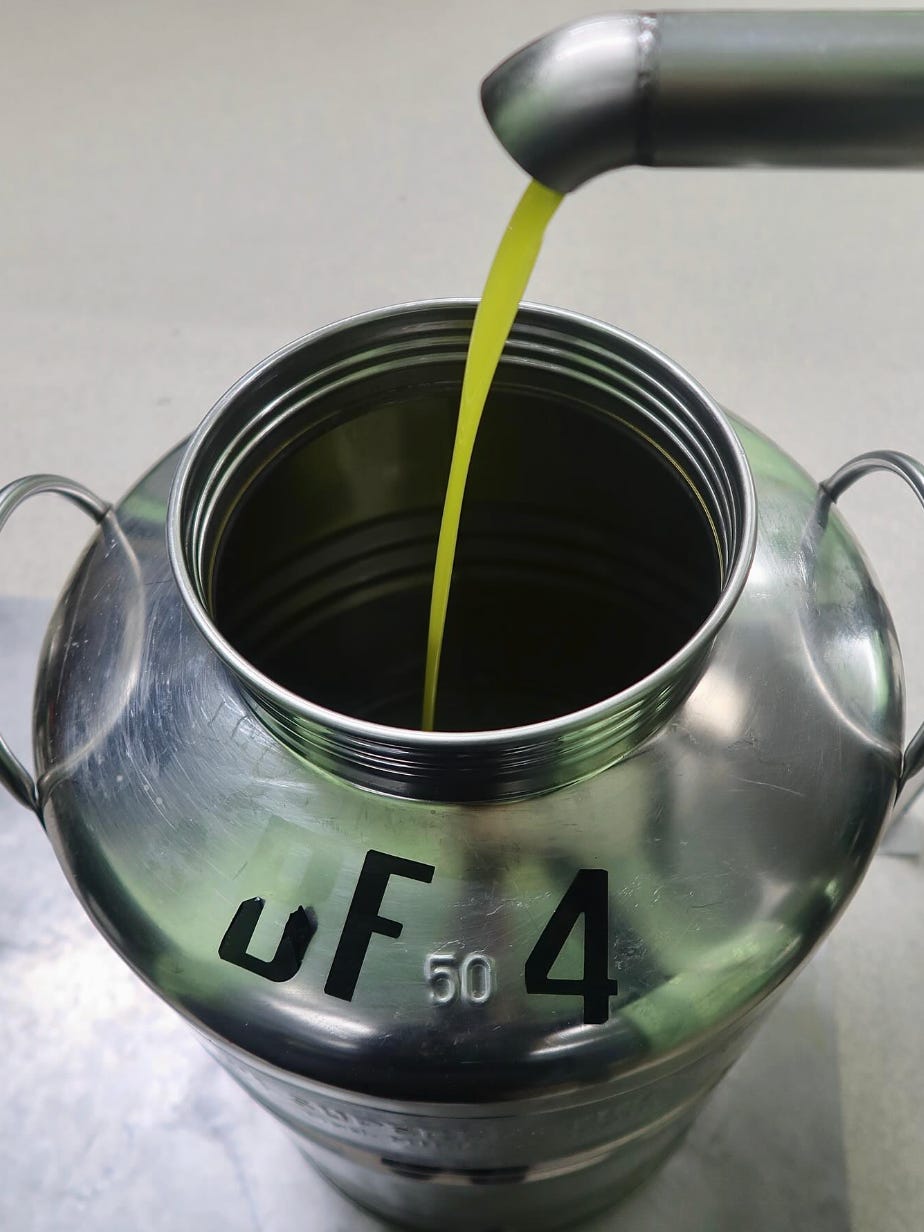
Packaging matters. Quality olive oil should come in dark, preferably opaque, glass bottles. Avoid clear bottles, which allow light to degrade the oil. Plastic is also a red flag, as olive oil is chemically sensitive absorbs micro-plastics easily. Thick, dark (ideally black) glass offers the best protection from light and heat. Non-reactive metals like stainless steel are also fine.
Another interesting packaging feature Bea uses: non-removable spout, which helps prevent counterfeiting or tampering. It ensures the bottle can’t be refilled with lower-quality oils.
Single Origin: Olives grown, harvested, and pressed on one estate produce a higher quality oil. For the best olive oil, look look for mention of the town where it’s produced and bottled, not just the name of its country of origin.
Sometimes a bottle could say '“product of Italy” but it’s bottled in the US, which results in a lower quality olive oil. Look for terms like “packaged-” or “bottled in.”
There are various certifications for single origin olive oil—in the same way that a wine can be “DOP certified” olive oil can be marked using similar markers. Terms like single origin, single estate, or lot number are popular because they show that olive oil is produced where the olives are grown and harvest as opposed to driving them a long way to a production facility, which isn't good for the health of the olives.
Filtering and Refining: Typically, filtration is required by grocery stores or large scale producers to elongate the shelf life of the oil. It's also sometimes used as an instrument to mask the flavor of poorly treated olives.
Unfiltered Olive Oil: is more nutrient-rich, Retaining all of its natural properties. In the bottle, it will be slightly cloudy like fresh orange juice with pulp. After 8–12 months, a natural layer of sediment will forms at bottom of bottle, making it ideal for fresh, immediate enjoyment.
Filtered: passed through a thin, paper film, filtered olive oil has a longer shelf life and a clean, vibrant, green color. With enhanced aromas of grass and pepper, it’s a great over beef or lamb, for roasting vegetables like eggplant or tomatoes, dressing hearty greens, or for dipping and finishing.
Bonus: olive varietals are listed either on the label or the brand’s website
To shop Bea’s Olive Oil, visit their website, beaoliveoil.com and follow them on Instagram for updates about harvest, restocks and events.
Maria Louise Rame
Thanks for schooling me! xx
absolutely